Femicore Ingredients: What's Inside and What the Research Says
Femicore combines four botanical extracts and five probiotic strains in a single daily capsule. This guide explains each of the nine Femicore ingredients in plain English: what it is, why it's in the formula, how strong the research is and what to watch out for.
If you just want the big picture, start with the summary table. If you want the details, each ingredient has its own section below.
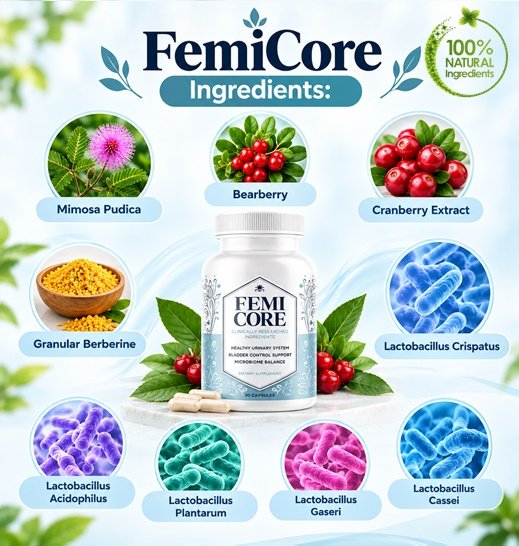
Femicore Ingredients at a Glance
| Ingredient | Type | Main role in Femicore | Evidence |
|---|---|---|---|
| Cranberry extract | Botanical | Helps stop bacteria sticking to the bladder wall | Strong |
| Lactobacillus crispatus | Probiotic | Cornerstone strain of a healthy female urogenital microbiome | Moderate |
| L. acidophilus | Probiotic | General microbiome support and diversity | Moderate |
| L. plantarum | Probiotic | Acid-resistant strain; supports gut-to-urogenital balance | Moderate |
| L. gasseri | Probiotic | Naturally found in the vaginal microbiome | Moderate |
| L. casei | Probiotic | Supports overall microbiome resilience | Moderate |
| Bearberry (uva ursi) | Botanical | Traditional herb for mild urinary complaints | Traditional |
| Berberine | Botanical | Influences bacterial activity and adhesion | Early |
| Mimosa pudica | Botanical | Gel-forming seed with "binding" properties | Limited |
"Evidence" reflects published research on each ingredient on its own, not on the finished Femicore formula, which has not been tested in a published clinical trial.
The Four Botanical Ingredients
1. Cranberry Extract
What it is: A concentrated extract of the North American cranberry (Vaccinium macrocarpon), standardized for proanthocyanidins (PACs) — the plant compounds believed to be responsible for its urinary benefits.
Why it's in Femicore: Type-A PACs appear to make it harder for E. coli, the bacteria behind most UTIs, to attach to the lining of the bladder. Bacteria that can't attach are more easily flushed out with urine.
What the research says: Cranberry is the best-supported ingredient in the formula. A 2023 Cochrane systematic review of 50 trials concluded that cranberry products reduce the risk of repeat symptomatic UTIs in women with recurrent infections. Evidence that cranberry reduces urgency or leaks on its own is much weaker.
Things to know: Many studies used around 36 mg of PACs per day, so it's worth checking how much PAC Femicore lists on its label. Cranberry is generally well tolerated, though people with a history of oxalate kidney stones or who take warfarin should check with a doctor.
2. Bearberry (Uva Ursi) Leaf
What it is: The leaf of a low-growing evergreen shrub (Arctostaphylos uva-ursi) that has been used in European folk medicine for urinary complaints for centuries.
Why it's in Femicore: Bearberry contains arbutin, which the body converts into compounds with antibacterial activity in the urinary tract.
What the research says: European herbal authorities, including Germany's Commission E and the European Medicines Agency, recognize bearberry as a traditional remedy for short-term relief of mild lower urinary tract symptoms. Modern clinical trials are few.
Things to know: Bearberry is the ingredient that calls for the most caution. Because arbutin breaks down into hydroquinone, traditional guidance limits use to about a week at a time and only a few times per year, and advises against it in pregnancy, breastfeeding, children and kidney disease. It can also turn urine greenish-brown, which is harmless. Since Femicore is marketed for continuous daily use, ask your doctor or pharmacist about the bearberry dose on the label before taking it long term.
3. Berberine
What it is: A bright-yellow alkaloid found in plants such as barberry, goldenseal and Oregon grape. It's best known as a supplement for blood sugar and metabolic health.
Why it's in Femicore: Laboratory studies show berberine can interfere with bacterial adhesion and biofilm formation, and it has broad effects on microbial communities.
What the research says: Promising in lab and animal studies; human trials specifically for bladder symptoms or UTIs are limited.
Things to know: Berberine is pharmacologically active. It can lower blood sugar and affects liver enzymes that process many medications, so it may interact with metformin, insulin, blood thinners, cyclosporine and others. It should not be used during pregnancy or breastfeeding. Digestive side effects such as constipation, diarrhea or cramping are fairly common.
4. Mimosa Pudica Seed
What it is: The seed of the "sensitive plant," which folds its leaves when touched. The seeds form a sticky gel when they meet water.
Why it's in Femicore: The manufacturer includes it for its gel-forming, "binding" and cleansing properties, intended to create better conditions for the probiotics.
What the research says: Mimosa pudica has been used in traditional systems such as Ayurveda, but there is very little human research on it for urinary or bladder health. It is the least-proven ingredient in the formula.
Things to know: Safety data are limited; avoid during pregnancy and breastfeeding.
The Five Probiotic Strains
For decades, healthy urine was assumed to be sterile. Newer testing methods have shown that the female bladder hosts its own small microbiome, which in healthy women is often dominated by Lactobacillus species. These bacteria produce lactic acid and other substances that make the environment less hospitable to harmful bacteria. Femicore's five strains are chosen to support that Lactobacillus-rich environment.
5. Lactobacillus Crispatus
The star of the formula. L. crispatus is the species most strongly linked to a healthy vaginal and urogenital microbiome. In a randomized trial, a vaginal suppository of L. crispatus reduced recurrent UTIs in women. Oral capsules are thought to work more indirectly, as bacteria travel from the gut to the urogenital area, so results may be slower and less dramatic than with vaginal products.
6. Lactobacillus Acidophilus
One of the most studied probiotics in the world. It supports overall microbial balance in the gut and vagina and is commonly included in women's probiotic formulas.
7. Lactobacillus Plantarum
A hardy strain known for surviving stomach acid and bile well, which helps more live bacteria reach the intestines. It has been studied for gut health and inflammation.
8. Lactobacillus Gasseri
Naturally present in the healthy vaginal microbiome. Femicore positions it for women going through hormonal transitions — postpartum, perimenopause and menopause — when falling estrogen levels can reduce Lactobacillus populations.
9. Lactobacillus Casei
A well-researched strain used in many fermented foods and supplements, included to support microbiome resilience and diversity over time.
What to check on the label: For probiotics, the important numbers are the total count of live bacteria (listed in CFU, or colony-forming units) and whether that count is guaranteed through the expiration date. Store the bottle as directed — some probiotics lose potency in heat and humidity.
How Femicore's Ingredients Work Together
The formula is built on two complementary strategies:
Strategy 1: Make it harder for harmful bacteria to settle
Cranberry PACs reduce bacterial adhesion to the bladder wall, while berberine and bearberry contribute antibacterial activity. Together, they aim to keep the urinary environment calmer and less irritated.
Strategy 2: Support the "good" bacteria
The five Lactobacillus strains aim to rebuild a healthy, protective bacterial community — especially after antibiotics, childbirth or menopause have disrupted it.
The theory is that a less irritated bladder with a healthier microbiome sends calmer signals, which may mean fewer sudden urges and nighttime trips. It's a logical model, but it hasn't been confirmed in a clinical trial of this specific product.
What Femicore Does Not Contain
It's just as useful to know what's missing. Femicore does not include:
- D-mannose — a sugar popular for UTI prevention, found in products such as Uqora.
- Pumpkin seed or soy germ extract — the main ingredients in AZO Bladder Control, aimed at overactive bladder.
- Synthetic hormones, stimulants or diuretics.
If you're comparing options, our Femicore vs AZO vs Uqora comparison explains which ingredient approach fits which bladder problem.
Reading the Femicore Supplement Facts Label
The Supplement Facts panel is the most reliable source of information about what's actually in each capsule. When you review it, look for:
- The serving size (one capsule) and servings per bottle (30)
- The amount of each botanical extract, and whether it's a proprietary blend
- The PAC content of the cranberry extract
- The probiotic CFU count
- Warnings, allergens and the capsule material (relevant if you're vegan)
Take a photo of the label to show your doctor or pharmacist, especially if you take prescription medication. For a full safety breakdown, see Femicore side effects, and for real-world results, read our Femicore reviews.
See Femicore Packages →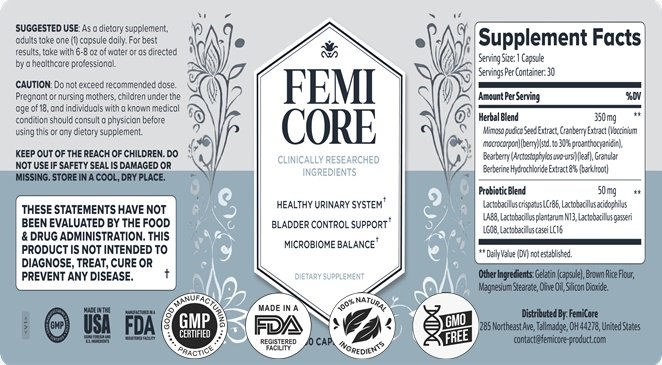
Femicore Ingredients FAQ
What are the ingredients in Femicore?
Femicore contains four botanicals, cranberry extract, bearberry (uva ursi), berberine and mimosa pudica seed, plus five probiotic strains: Lactobacillus crispatus, L. acidophilus, L. plantarum, L. gasseri and L. casei.
Which Femicore ingredient has the strongest evidence?
Cranberry extract. A 2023 Cochrane review of 50 studies found cranberry products reduce the risk of repeat symptomatic UTIs in women with recurrent infections.
Why does Femicore contain Lactobacillus crispatus?
L. crispatus is the species most strongly associated with a healthy female urogenital microbiome, and it has been studied for reducing recurrent UTIs.
Does Femicore contain D-mannose?
No. Femicore does not contain D-mannose. Its anti-adhesion support comes from cranberry proanthocyanidins (PACs).
Is bearberry safe to take every day?
Traditional European guidance recommends bearberry for short-term use only, usually no more than about a week at a time, because it contains arbutin, which converts to hydroquinone. Ask your doctor before taking a bearberry-containing product long term.
Is Femicore vegan?
The active ingredients are plant-based and probiotic, but the capsule material may vary. Check the label or ask customer support if you follow a strict vegan diet.